

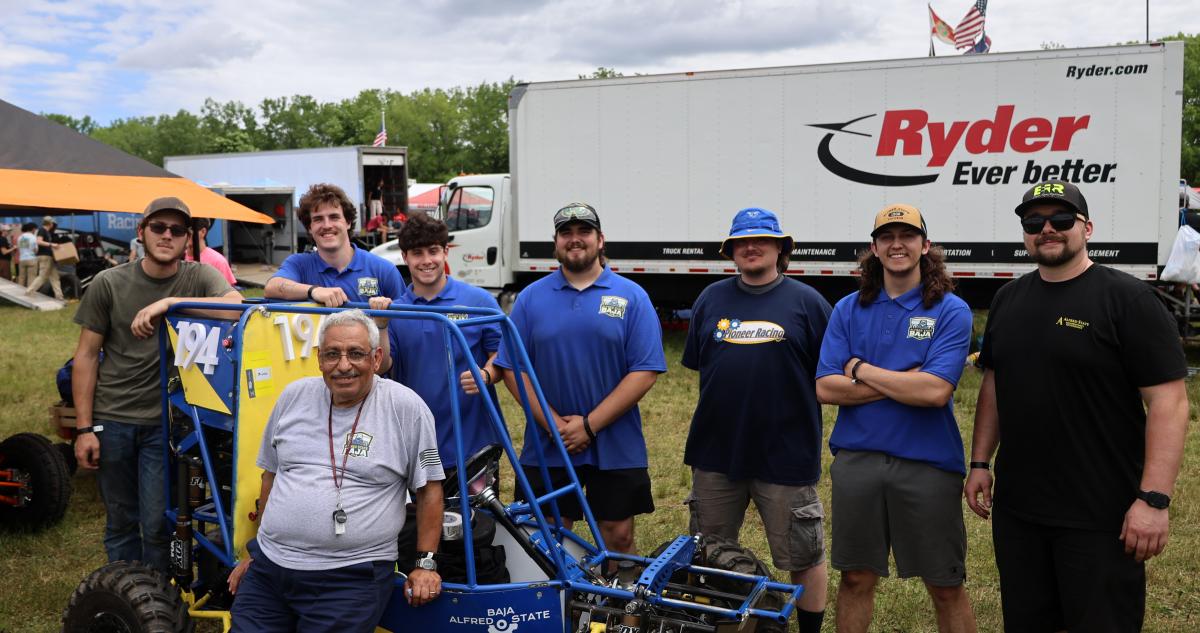
A six-person team of Alfred State engineering students took classroom concepts beyond the lab and into one of the most demanding collegiate engineering competitions in the world, competing in the Society of Automotive Engineers (SAE) International Baja SAE competition in Palmyra, NY.
Mechanical and Electrical Engineering Technology Assistant Professor Mohamed Eleshaky and Motorsports Instructor Caryl Koch guided Cameron Dopman (Corning, NY), Dallas Ecker (Albion, NY), John Heimer (Gloversville, NY), Adam Karam (Cortland, NY), Joshua Mallabar (Grand Island, NY), and Nick Steurrys (Williamson, NY). They competed with 102 different colleges from across the United States, Canada, and beyond.
Watch the Alfred State Baja SAE video
Photo gallery of Baja SAE competition
Baja SAE challenges teams to design, build, test, and race a single-seat, off-road recreational vehicle capable of enduring some of the harshest terrain imaginable. Throughout the year-long process, students are responsible for every aspect of the project, from engineering design and manufacturing to budgeting, sponsorship development, project management, and technical problem solving. The race in New York was one of three held this year (Oregon and Ohio).
The experience extended far beyond building an off-road vehicle for team leader Karam, “It is lots of fun. Once you get here and see all the different designs, you realize there are so many ways to solve engineering problems. If we ran into an issue, other teams were willing to help us out. There's a great community here."
Heimer saw the project as an opportunity to turn a lifelong passion into a real engineering experience. "I've always loved working on cars. I grew up tinkering on my own vehicles, so getting the opportunity to compete and put those skills to use is exactly why I wanted to be part of this team."
Karam added, "You learn real-world things, like figuring out what doesn't fit, how to redesign it while staying within the rules, and how to solve problems on the fly. Beyond engineering, I learned about budgeting, sponsorships, communication, delegation, and managing a team. Honestly, I've learned more during this process than I would in any individual class."
The competition requires months of planning, fabrication, testing, and refinement before teams ever arrive at the starting line. Students spend countless hours balancing academics with late nights in the shop, working together to prepare their vehicle for competition.
Heimer continued, "We were able to get it (the car) back up to the current rules and make it to competition. After all the long days we've put into it, just getting the car to the race was a huge accomplishment."
While the competition ultimately tests the durability and performance of the vehicle, it also prepares students for careers in engineering by requiring them to think critically, collaborate effectively, and solve complex challenges under real-world constraints.
SAE International is a global association representing more than 145,000 engineers and technical experts. The competition mirrors the collaborative environment students will encounter throughout their professional careers. Teams are evaluated not only on vehicle performance but also on design, manufacturing quality, cost analysis, and business presentations.